Showing posts with label Ferrari. Show all posts

Monday, October 11, 2010

Monday, September 6, 2010

Ferrari removes bar code design

https://blogger.googleusercontent.com/img/b/R29vZ2xl/AVvXsEjUeLU3y6ww6TzfU1GLGrC0dlYksKmVWX1do5vOua2bF6Sxudp_n8cFIXB-LTMu-7Vf6ud-UTq8Y-lX78-t0NkriqyQP1KFAhOl3U1fM2w_qjEHBi8Aj0v7iXEKg8bkksUv-dgaQemLw2cx/s400/2010.ferrari.scuderia+spider+16m.20269947-396x249.jpg
Ferrari began Friday practice for the Spanish Grand Prix without a controversial bar code design on its chassis, following suggestions it was subliminal advertising for Marlboro cigarettes.
http://static.howstuffworks.com/gif/2010-ferrari-millechilli-1.jpg

The Formula One team said the decision was taken "to remove all speculation" that the large bar code on its paintwork was associated with its princial sponsor. However Ferrari said the idea of the design being advertising for Marlboro was "ridiculous."

Cigarette sponsorship in F1 was once common but has all but disappeared due to advertising bans in most countries where races are held. Ferrari are the only team that is still sponsored by a tobacco company. It's official name Scuderia Ferrari Marlboro.

Sunday, September 5, 2010

Ferrari 458 Italia Oakley Design

Ferrari 458 Italia Oakley Design

The tuners at Oakley Design have released the updates for the Ferrari 458 Italia package that will increase the production to seven cars, instead of the previously planned five. High demand for this unique Ferrari car has pushed the tuning company to make a couple more, and each will hold an individual numbered plaque. A new carbon fiber front spoiler lip was installed, which increased the downforce by 25kg after some wind tunnel testing. A rear spoiler added an additional 23kg to the rear axle, and both of these test were completed at 150 mph. Other exterior modifications include the Oakley Design carbon fiber roof panel, mirror covers, and engine cover below the rear window glass.

New lightweight HRE forged wheels were installed, saving 5kg of weight per each rim. Oakley offers a 20×9 and 20×11 wheels for the Ferrari 458 Italia, which come wrapped in high performance Pirelli Trofeo tires. Performance improvements include a modified throttle response and larger carbon fiber air intake box. An ECU recalibration optimizes the fuel output and ignition curves, that result in a power increase from 570 bhp to 623 bhp.

At the track the custom Ferrari 458 acceleration was improved with a 0 to 100 k/h time of 3 seconds flat. The top speed for this car was recorded at 335 km/h or 208 mph. For the hardcore track day drivers, a bespoke suspension kit is in development at Intrax, who are the suspension partner with Oakley Design. For customers looking to complete the whole package, a matching Ducati 1198 “Carbon Edition” is included for the full Italian package.

Ferrari 458 Italia Oakley DesignFerrari 458 Italia Oakley Design

Sunday, August 22, 2010

Ferrari Car

http://www.2dayblog.com/images/6-novitec-ferrari-f430.jpg

http://images.eurotuner.com/eventcoverage/160_0611_et_11_z+2006_la_convention_center_vip_auto_fashion_car_show+ferrari_passenger_view.jpg

The image “http://images.eurotuner.com/eventcoverage/160_0611_et_16_z+2006_la_convention_center_vip_auto_fashion_car_show+mercedes_benz_driver_view.jpg” cannot be displayed, because it contains errors.

The image “http://images.eurotuner.com/eventcoverage/160_0611_et_14_z+2006_la_convention_center_vip_auto_fashion_car_show+porsche_driver_view.jpg” cannot be displayed, because it contains errors.

In the automotive industry it is very difficult to establish a delicate balance between how exclusive the car is, producing enough of the these elusive vehicles to create a demand and profit while still holding back enough that even the people who can afford it can not purchase these exotic beasts on a whim. No other company has managed to achieve this delicate balance as successfully as Ferrari.
In general for any of the exclusive Ferrari models the waiting list is approximately 2 years. Ferrari also uses a centralized system that enables both the company and its dealers to place individuals who have already purchased a Ferrari higher on the list.
http://www.ferrari48.com/pictures/car-styling-ferrari-cars.jpg

http://www.ferrari48.com/pictures/car-specifications-ferrari-cars.jpg
http://www.ferrari48.com/pictures/cool-ferrari-picture.jpghttp://www.madwhips.com/upload/images/ferrari_430_race_cars_at_mid_ohio_6-568-426.jpg
The image “http://www.mccullagh.org/db9/1ds-5/ferrari-enzo-2.jpg” cannot be displayed, because it contains errors.

Sunday, August 15, 2010

Ferrari 599 GTO Sports Car Design

The Ferrari 599 GTO is, in fact, the company's fastest ever road car. It is an exclusive limited edition special which, in true Ferrari tradition, is a completely new concept, albeit inspired by a production car. In fact the Ferrari 599 GTO is based on the 599XX, the advanced experimental track car, and can be considered almost a road-going version. The Ferrari 599 GTO is reserved for just 599 clients who seek the maximum expression of high-performance driving. The Ferrari 599 GTO benefits directly from the technological transfer from racing and set a record lap time at Fiorano in 1'24".
Ferrari 599 GTO
The Fiorano lap time provides just one indication of the potential of this car. Just as significant are the technical specifications - 670 hp in a 1495kg car represents a weight-to-power ratio of just 2.23 kg/hp, and ensures a 0-100 km/h acceleration time of just 3.35" as well as a top speed of over 335 km/h.
As is Ferrari's policy, every new Ferrari features new solutions for a road car. Thus the Ferrari 599 GTO is equipped with the latest, second-generation carbon-ceramic brakes which are lighter and offer better performance, new aerodynamic innovations, such as the wheel doughnuts which increase aerodynamic efficiency as well as improve brake cooling, and the Super sport tyres developed by Michelin include a wider front tyre for greater roadholding. The driver-car interface is also new with the adoption of the Virtual Race Engineer (VRE) which provides the driver with instantaneous information on performance.
The GTO (Gran Turismo Omologata) moniker instantly calls to mind two Ferraris that have entered the collective imagination as symbols of performance. After the 1962 250 GTO, which swept the boards in GT racing categories in the 1960s and is now a highly prized collector's car, came the iconic 1984 GTO, which basically invented the entire modern supercar genre.
The web special includes photos, videos and interviews on the new car, while an exclusive preview for a small number of Ferrari clients will be held on April 14th at the Military Academy in Modena. The public debut of the Ferrari 599 GTO will instead be at the Beijing International Motor Show at the end of April.
The Ferrari 599 GTO's engine is directly derived from the 599XX unit implementing, however, the necessary modifications for road-going homologation. It thus complies with Euro 5 and LEV 2 standards. The 5999 cc 65-degree V12 engine punches out 670 CV at 8250 rpm with maximum torque of 620 Nm at 6500 rpm and there is a smooth, constant rush of power all the way to the redline with no loss of flexibility even at medium and low revs. This result was obtained by working on the fluid-dynamics and components to reduce internal friction and by adopting, amongst other things, the 599XX's redesigned crankshaft. The car also has a racing-type intake system with a new manifold with diffuser-type intake geometry and short inlet tracts designed to improve power delivery at high revs and reduce losses. To maximise volumetric efficiency per cylinder, a connection between the two plenums at the front compensates for variations in the volume. This is how the engineers managed to achieve maximum performance at high engine speeds. The engine sound inside the car is carefully controlled to balance the intake sound with the exhaust, which features a 599XX-derived 6-into-1 manifold.
The Ferrari 599 GTO inherits much of the development work - using the same principles as employed in F1 - that went into making the 599XX such an extreme performance car. Reducing weight was a vital objective and the result was the widespread use of composites and components manufactured with technologies more akin to racing specifications. The areas involved include the bodywork and greenhouse (with thinner gauge aluminium and thinner glass), the brakes, transmission and exhaust system. The result is a dry weight of 1495 kg and a weight-to-power ratio of just 2.23 kg/hp, a very significant figure that underlines the GTO's performance potential.
The Ferrari 599 GTO's aerodynamics have benefited significantly from Ferrari engineers' experience in F1 and with the 599XX which allowed downforce to be greatly increased without impacting on drag. Thanks to solutions transferred from the track car to the road-going version, the GTO generates downforce of 144 kg at 200 km/h. The entire car was honed, including the front, the sides, the flat underbody and cooling flows. In the latter instance, the GTO can count on improved ducting to the brake discs and pads, and the adoption of wheel doughnuts - a disc positioned outside the brake disc that ensure that hot air exiting the wheelarch stays as close to the body of the car as possible to reduce drag.
The new CCM2 braking system is lighter and even more consistent in high performance situations. Its consistent coefficient of attrition meant that the ABS could be calibrated to a particularly high performance level, further reducing lap times, thanks to improved deceleration and shorter stopping distances. In fact, the Ferrari 599 GTO boasts an excellent 100 to 0 km/h braking distance of just 32.5 metres. As well as their role in improving aerodynamics, the Formula 1-derived wheel doughnuts also improve braking efficiency by optimising brake cooling.
The car-driver interface was designed to maximise car and driver performance with a layout of the main commands that ensures absolute efficiency and minimum distraction. The Racing manettino also puts the emphasis firmly on sporty, track-specific driving settings by offering the driver full choice with regard to the electronic control parameters. The ICE position on the Ferrari 599 GTB Fiorano has been replaced by CT-Off (traction control off). The GTO is also fitted with bespoke, longer carbon-fibre F1 paddles for easier use in high-speed driving. In addition the GTO also features the Virtual Race Engineer, a system that monitors the status of the car and gives the driver immediate visibility of vehicle performance.

Wednesday, August 11, 2010

Sport Car Ferrari F430


Ferrari F430 is a sports car manufactured by Ferrari. The F430's brakes were collaboratively designed with Brembo. The F430 features E-Diff, a computer-controlled limited slip differential which enables to vary torque distribution based on inputs such as steering angle and lateral acceleration.

Saturday, July 31, 2010

Ferrari Sports Cars 612 Scaglietti a Sporty Coupé

The 612 Scaglietti is the result of an avant-garde design that continues the great Ferrari 2+2 tradition. Styled by Pininfarina, the 612 Scaglietti is named in honour of Sergio Scaglietti, the Modenese stylist and coachbuilder responsible for bodying some of the most beautiful Ferraris Sports Cars of the 1950s and 60s.
Ferrari Sports Cars 612 Scaglietti a Sporty Coupé
The 612 Scaglietti epitomises Ferrari's talent for innovation and design. This exhilaratingly nimble, beautifully balanced sporty front-engined rear-wheel drive berlinetta offers a cockpit capable of accommodating four occupants in unprecedented comfort. The 612 Scaglietti isn't just a 2+2 but a spacious two-door four-seater that's a pleasure to be aboard in any driving conditions.
While the Ferraris Sports Cars 612 Scaglietti has the heart of a sporty coupé, its luxurious dimensions and design are that of a surprisingly roomy Granturismo. Its deft Pininfarina styling is as innovative as its design, underscoring its dynamism and power. The result is an imposingly sculptural car with a long sleek bonnet, strong lines and signature scooped flanks borrowed from the famous Rossellini-Bergman 375 MM.
The 612 Scaglietti was the very first all-aluminium Ferrari 12-cylinder. It's no surprise therefore, that it is named in honour of Sergio Scaglietti, the Modenese coachbuilder who worked with Enzo Ferrari in the early years of his great adventure, masterfully sculpting some of the most famous track and road-going Ferraris ever from that very metal (which is just a third of the specific weight of steel). Both the 612 Scaglietti's chassis and bodywork are aluminium.
The 612 Scaglietti's innovative panoramic stratified glass roof extends right across the top of the cockpit from windscreen to rear window, giving all four occupants a drop-top driving sensation of spaciousness and airiness. There are three tint level settings to allow occupants adjust the amount of sunlight allowed into the car.
The 612 Scaglietti's braking system features CCM (carbon ceramic material) discs, making it highly responsive and efficient even in the most intense driving conditions. The 612 Scaglietti's brakes are also exceptionally resistant to fading and thus guarantee effective braking in high-stress driving situations. The use of CCM technology guarantees enhanced ride quality too. The 612 Scaglietti's wheels have been selected for optimal performance and weight reduction.
Ferrari's team of highly-experienced, passionate artisan cockpit trim experts ensure that every 612 Scaglietti leaves Maranello with an elegantly sophisticated and sporty cockpit honed to meet the tastes of its owner. This bespoke quality and exclusivity means that owners can choose from a range of dash panel inserts, seat trims and side panels.
The easy-to-reach main controls for the onboard infotainment system are also steering wheel-mounted. The dual zone climate control automatically adjusts cockpit temperature, humidity levels and ventilation. An 8-channel Surround Sound audio system was developed specifically for the cockpit so that the acoustics are on a par with the best Home Theatre system, in all driving conditions.
The 612 Scaglietti is powered by an imposing 5,748 cm³ 65° V12 that delivers 540 CV at 7,250 rpm, 98 CV more than the 456M's 5,474 cm³ unit. The engine has been worked upon on various levels to optimise performance and improve fluid dynamics. Specifically, it boasts more direct air intake tracts with two ducts from the radiator grille opening on the front bumper, new exhaust system geometries and volumes to reduce back-pressure, a boosted compression ratio (11.2:1), and inlet tracts and exhaust porting with improved fluid dynamic characteristics.
It is controlled by a Bosch Motronic ME7 ECU. Meticulous honing of the 612 Scaglietti's dynamic handling has resulted in prompt yet smooth responsiveness, making it easier to control in all kinds of conditions.

Wednesday, July 28, 2010

NOVITEC ROSSO Sports Car Refines the Ferrari California

Novitec Rosso has released their sporty styling and performance package for the new Ferrari California. Novitec Rosso Ferrari California comes with a custom-tailored tire/wheel combination with diameters of 21 and 22 inches, suspension modifications, more power and exclusive interior options. The
NOVITEC ROSSO Refines the Ferrari California
The Ferrari California 4.3-liter V8 engine power increases by 40 hp / 29.4 kW to 500 hp / 368 kW. Simultaneously peak torque grows from 485 to 518 Nm at 5,300 rpm : NOVITEC ROSSO now also refines the new Ferrari California.
Tasteful refinements with aerodynamic benefits characterize the NOVITEC ROSSO design program for the sports car from Maranello. All aerodynamic-enhancement components are made from especially lightweight yet high-strength clear-coated carbon fiber. The NOVITEC ROSSO front spoiler attaches to the production bumper and lends the sports car an even more striking face. Its sophisticated shape further reduces lift on the front axle for even better directional stability at high speeds.
To reduce lift on the rear axle and thus achieve an optimal aerodynamic balance NOVITEC ROSSO equips the California with a newly designed diffuser for the rear apron and a spoiler lip on the trunk lid.
Three-piece NOVITEC ROSSO NF3 wheels also play a major role in the even more stunning appearance of the refined Ferrari. By choosing a staggered combination of size 9Jx21 wheels in front and size 11.5Jx22 on the rear axle NOVITEC ROSSO further emphasizes the wedge shape of the car.
Technology partner Pirelli supplies high-performance tires custom-tailored to this Ferrari. Aerodynamic and styling changes include new rocker panels with integrated airfoils and black side markers, a rear diffuser, rear spoiler lip and carbon fibre rear molding. Wheels are 9Jx21 size in front and 11.5Jx22 at the rear, shod with 255/30 ZR 21 and 315/25 ZR 22 Pirelli tyres respectively.
NOVITEC ROSSO sport springs are custom-calibrated to match these ultra-low-profile tires, and lower the ride height by some 35 millimeters. At the same time the NOVITEC ROSSO specialists have developed an additional feature to further improve the everyday utility of the Ferrari California.
The NOVITEC ROSSO hydraulic front lift system raises the front of the car by some 40 millimeters at the push of a button in the interior. That allows drivers to safely navigate parking garage ramps or speed bumps. At a second push of the button or automatically when reaching a speed of 80 km/h the front reverts to its original position.
This injection of extra power comprises on the one hand a newly calibrated engine management system with custom mapping for injection and ignition, including a new higher redline speed of 8,300 rpm. The tuning package also includes the NOVITEC ROSSO stainless-steel high-performance exhaust system with metal catalysts and a flap actuator operated from the Manettino switch on the steering wheel.
NOVITEC ROSSO fulfills customer demands for interior customization with perfectly finished leather and Alcantara interiors. The choice of available colors and meticulously sewn upholstery designs is virtually unlimited.

Novitec Rosso Super Sports Cars Edizione 747 Bi-Compressor Engine

The Ferrari 430 Scuderia is already one of the hottest-performing supercars on the market, but some people just don't know how to leave well enough alone. Some of those people work at Ferrari, who've worked tirelessly on the 458 Italia to supplant the 430's already legendary performance. And some of those people work for Novitec Rosso, who've come back yet again with another mod job for the Italian stallion.
2010 Novitec Rosso Super Sports Cars Edizione 747 Bi-Compressor Engine
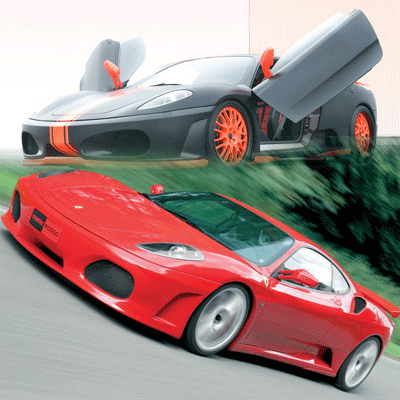
It takes its name from its rated power output of 747 horsepower: To mark the farewell of the Ferrari 430 Scuderia, NOVITEC ROSSO presents the Edizione 747. The world’s leading tuner of the super cars from Maranello turns the lightweight model into one of the most powerful super sports cars of our time. And with its matte yellow and grey paintjob it is also one of the most spectacular-looking cars of our time.
Called the Edizione 747, the custom Scuderia may not be as big as a jumbo jet, but it packs nearly as much thrust. Strapping a pair of superchargers to that high-revving 4.3-liter V8, along with a few more tweaks here and there, brings output up from an impressive 510 horses to a bonkers 747 horsepower. Intercoolers and revised aerodynamic cooling keep the engine running cool. 
Twenty-inch NF3 rims wear Michelin Pilot Sport Cup rubber mounted to sport springs that drop the ride height by a further 30 milimeters, available with an adjustable front end that can lift 40 mm to clear curbs and speed bumps at the touch of a button. Novitec's also decked out this particular example with a two-tone yellow and matte black paint scheme, and given the interior a few mods to complete the package.
At the heart of this special model lies the 2010 new NOVITEC ROSSO 747 Bi-Compressor engine that boosts power output of the V8 that normally produces 510 hp / 375 kW by 237 hp / 174 kW. Driving performance improves accordingly: With a sprint time for 0 – 100 km/h of less than 3.4 seconds, 9.4 seconds to 200 km/h and just 22.9 seconds to 300 km/h the NOVITEC ROSSO model is the most powerful and quickest Scuderia in the world. Just as impressive is the top speed of 351 km/h.
The Edizione 747 specification is the ultimate high-end version and is limited exclusively to the Berlinetta model of the Ferrari 430 Scuderia. The layout of the engine conversion corresponds to all NOVITEC ROSSO Bi-Compressor conversions for the mid-engine sports car. Each cylinder bank is fitted with an intercooler and a cogged-belt-driven high-performance supercharger with a maximum boost pressure increased for this version to 0.53 bar. 
The intercooling system features its own dedicated water circuit. The radiator of the system is located behind a special centrally placed air duct in the front apron. To guarantee perfect durability even under high ambient temperatures the conversion also includes more effective radiators for water and oil.
The result of this labor is a unique symbiosis of superior power and excellent running smoothness. With a rated power output of 747 hp / 549 kW at 8,500 rpm the NOVITEC ROSSO Edizione 747 Bi-Compressor engine surpasses its naturally aspirated brethren by 237 hp / 174 kW. The increase in torque from standard 470 Nm to 738 Nm at 6,300 rpm represents an enormous plus in low-speed power.
As a tribute to the outgoing Ferrari 430 Scuderia, Novitec Rosso has unveiled its new Edizione 747. As the name suggests, the V8 engine has been upgraded with a bi-compressor to produce a total of 747-hp with a maximum torque of 544 lb-ft. 0-62 mph comes in just 3.4 seconds while 0-124 mph takes 9.4 seconds. To speed comes in at 218 mph. Novitec also threw in a new intercooling system that features its own dedicated water circuit and is given a maximum boost pressure figure of 0.53 bar.
To lend the Scuderia better suitability for everyday use despite the lowering NOVITEC ROSSO offers an innovative hydraulic lift system for the front axle. At the push of a button in the cockpit the front is raised by 40 millimeters. It allows drivers to safely navigate parking ramps, low curbs and speed bumps. 
After safely passing over the obstacle, another push of the button reverts the suspension to its original position. If the button is not pushed the front end reverts to its original position automatically once the car reaches a speed of 80 km/h.